
And God Said Maxwell's Equations and There Was Light: What Does It Really Mean?
There is a famous joke, or perhaps a profound observation, that circulates among physicists and science enthusiasts: "And God said Maxwell's equations and there was light."
At first glance, it looks like a clever twist on a biblical line. But behind the humor lies one of the most important discoveries in physics. The phrase points to the moment when scientists realized that light is not just something we see, but something that can be fully described by mathematical laws.
The idea is simple but powerful. Maxwell's equations showed that light is an electromagnetic phenomenon. In other words, light is not a mysterious glow. It is a wave made of electric and magnetic fields, governed by precise rules.
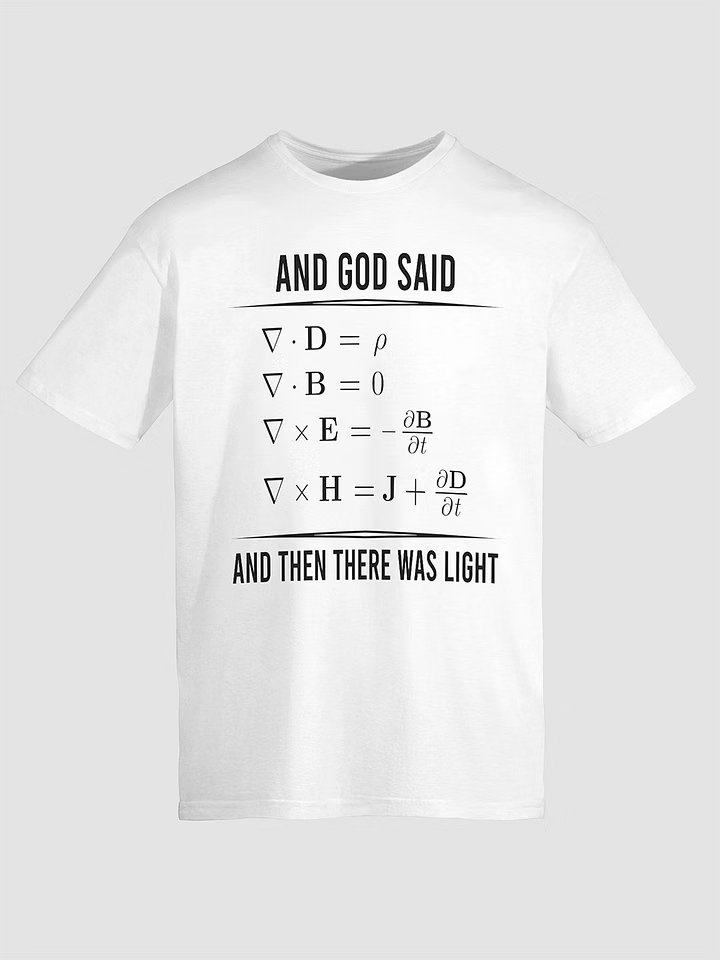
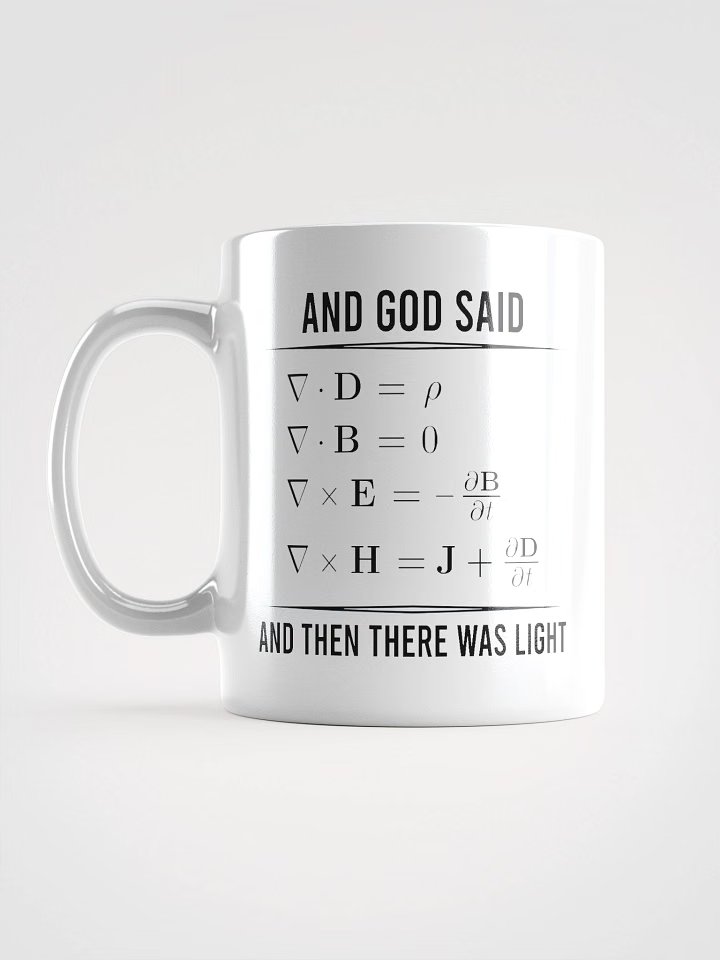
This is why the phrase resonates so strongly online. It combines religion, science, and humor into a single sentence. More importantly, it reflects a turning point in human knowledge, when light went from being a mystery to something we could understand, calculate, and predict. Today, that same idea even inspires designs like this Maxwell's equations collection, where science and culture meet in a visual way.
What Does "And God Said Maxwell's Equations and There Was Light" Mean?
The phrase is a playful rewrite of the biblical sentence "Let there be light." Instead of divine words creating light, the joke suggests that Maxwell's equations "explain" light into existence.
Of course, this is not meant literally. The deeper meaning is scientific. Maxwell's work showed that electricity, magnetism, and light are all part of the same phenomenon, known as electromagnetism. Before his discoveries, these were treated as separate areas of study. After Maxwell, they became one unified theory.
What makes the joke especially powerful is that it reflects a real mathematical result. If you take Maxwell's equations and work through the math, you can derive wave solutions that travel at about 300,000 kilometers per second, which is the speed of light. Light does not need to be assumed. It emerges naturally from the equations.
So the humor works on two levels. On the surface, it is a playful mix of science and religion. On a deeper level, it celebrates the fact that a small set of equations can explain something as fundamental as light itself.
Who Was James Clerk Maxwell?
James Clerk Maxwell was one of the most influential scientists in history. Born in 1831 in Scotland, he made groundbreaking contributions to physics that continue to shape modern science and technology.
Maxwell is best known for developing the classical theory of electromagnetism. His work unified electricity and magnetism into a single framework and showed that light is part of that same system. This was a major shift in scientific thinking.
Before Maxwell, scientists like Michael Faraday had discovered important relationships between electric and magnetic phenomena. However, these ideas were mostly experimental and lacked a complete mathematical description. Maxwell changed that. He translated these observations into equations that could describe how electric and magnetic fields behave and interact.
His influence was so profound that Albert Einstein once described Maxwell's work as one of the most significant changes in our understanding of reality since the time of Isaac Newton.
Maxwell's contributions did not stop at electromagnetism. He also worked on color vision, the kinetic theory of gases, and even produced the first color photograph in 1861. Despite his wide-ranging achievements, it is his equations that remain his greatest legacy.
What Are Maxwell's Equations?
Maxwell's equations are four fundamental laws that describe how electric and magnetic fields behave and interact. Together, they form the foundation of classical electromagnetism.
In simple terms, the equations tell us:
- Electric charges produce electric fields
- Magnetic fields are associated with moving charges
- Changing magnetic fields create electric fields
- Changing electric fields create magnetic fields
This last point is especially important. It shows that electric and magnetic fields are deeply connected and can sustain each other even in empty space. This interaction is what allows electromagnetic waves to exist.
Historically, Maxwell's original formulation was more complex, involving many separate equations. Later, scientists like Oliver Heaviside simplified them into the four compact equations we use today.
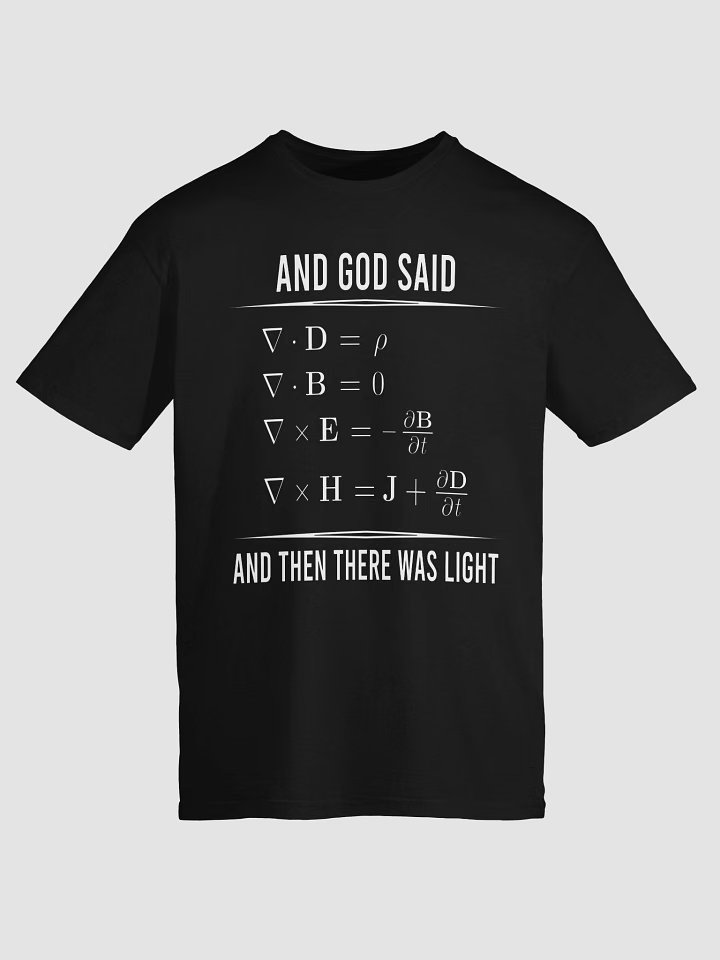
These equations do far more than describe static electricity or magnets. They predict the existence of electromagnetic waves and explain a wide range of phenomena, from radio signals and Wi-Fi to X-rays and visible light. In fact, much of modern technology depends on the principles encoded in Maxwell's equations. This is also why they are often featured on educational and creative items like a Maxwell's equations T-shirt, turning abstract physics into something tangible and shareable.
Why Do Maxwell's Equations Create "Light"?
Strictly speaking, Maxwell's equations do not "create" light. Instead, they reveal that light is an electromagnetic wave.
When Maxwell combined his equations and analyzed their behavior, he discovered something remarkable. The equations allow for wave-like solutions, meaning that electric and magnetic fields can oscillate and travel through space. These waves move at a speed determined by physical constants, given by the formula:
c = 1 / √(μ0ε0)
When scientists plug in the values for these constants, the result is approximately 3 × 10⁸ meters per second, which is exactly the speed of light.
This was not a coincidence. It led Maxwell to conclude that light itself is an electromagnetic wave. In other words, light is a self-sustaining cycle where changing electric fields create magnetic fields, and changing magnetic fields create electric fields.
This discovery was later confirmed experimentally by Heinrich Hertz in 1888, when he detected radio waves, proving that electromagnetic waves exist beyond visible light.
So when people say "And God said Maxwell's equations and there was light," they are pointing to a deep scientific truth. The equations do not magically produce light, but they make its existence inevitable within the framework of physics. They show not just how light behaves, but why it exists at all.
The Deeper Meaning Behind the Quote
Beyond the humor, the phrase points to one of the most important achievements in the history of physics: unification. Maxwell's theory showed that electricity and magnetism are not separate forces, but different aspects of a single phenomenon called electromagnetism. Even more remarkably, it revealed that light itself belongs to this same system.
This is what gives the quote its lasting impact. It is not really about creation, but about understanding. For centuries, light had been studied as something distinct, something almost mysterious. Maxwell's equations changed that by showing that light is simply a traveling disturbance in electric and magnetic fields.
There is also a deeper philosophical layer. The idea that a set of mathematical equations can describe something as fundamental as light raises an important question: why does mathematics work so well in describing the universe? Physicists often express a sense of awe at this fact. The equations are abstract, yet they map perfectly onto reality.
In that sense, the phrase can be read as a celebration of human knowledge. It captures the moment when a natural mystery was translated into a precise and elegant language. Rather than diminishing the wonder of light, Maxwell's work deepens it by showing how simple rules can produce something so universal and essential.
Why the Phrase Became Popular Online
The phrase became popular because it combines three powerful elements: familiarity, humor, and intellectual appeal. The structure echoes a well-known biblical line, which makes it instantly recognizable even to people without a strong background in physics.
At the same time, it resonates strongly with students, engineers, and science enthusiasts. Maxwell's equations are often introduced as a cornerstone of modern physics, so the phrase feels like an inside joke that rewards a bit of knowledge. Once someone understands the connection between electromagnetism and light, the joke becomes clear and satisfying.
It also works extremely well as a visual and cultural meme. The contrast between sacred language and mathematical notation creates a striking image. This is why the phrase frequently appears on T-shirts, posters, and social media posts. It signals both humor and intellectual identity. You can even find this idea translated into everyday objects like a Maxwell's equations mug, blending science with daily life.
Another reason for its popularity is that it serves as a teaching tool. Educators often use the phrase to spark curiosity. It provides a memorable entry point into a complex topic, helping learners connect an abstract theory to a familiar idea. In a single sentence, it invites people to ask a deeper question: how can equations explain light?
Common Misunderstandings
Despite its popularity, the phrase is often misunderstood in several ways.
One common mistake is taking it literally. Maxwell's equations do not "create" light. They are mathematical descriptions of how electric and magnetic fields behave. What they show is that electromagnetic waves can exist, and those waves include light.
Another misunderstanding is thinking that the quote comes from Maxwell himself. It does not. It is a modern joke inspired by the biblical phrase "Let there be light" and by Maxwell's scientific contributions.
Some people also assume that Maxwell discovered light. In reality, light had been studied for centuries. Scientists like Thomas Young had already shown that light behaves as a wave. Maxwell's breakthrough was proving that this wave is electromagnetic in nature.
There is also a technical misconception worth noting. The four equations we use today are not exactly how Maxwell originally wrote them. His work was later simplified into the modern form by physicists such as Oliver Heaviside. While the physics is Maxwell's, the compact version seen in textbooks and on T-shirts is the result of later refinement.
Finally, it is important to remember that Maxwell's equations are part of classical physics. They are extremely accurate in most situations, but at very small scales, a more complete theory called quantum electrodynamics is needed. Even so, Maxwell's equations remain one of the most powerful and widely used tools in science and engineering.
Why People Search This Phrase
Most people encounter this phrase in a casual context, such as a meme, a T-shirt, or a social media post. The wording sounds dramatic and philosophical, which naturally sparks curiosity. People want to know whether it is just a joke or if there is a deeper meaning behind it.
Others search for the phrase because they are learning physics. Maxwell's equations can feel abstract and difficult at first, so a memorable line like this offers a more intuitive way to approach the topic. It acts as a shortcut to a key idea: light is part of the electromagnetic spectrum.
There is also a cultural reason for its popularity. The phrase sits at the intersection of science, religion, and language. This makes it appealing not only to science enthusiasts, but also to readers interested in philosophy or the relationship between scientific discovery and broader human thought.
In many cases, the search begins with simple curiosity but leads to a deeper exploration. From a single sentence, people can discover the history of electromagnetism, the work of Maxwell, and the fundamental nature of light. That makes the phrase more than just a joke. It becomes a gateway into one of the most important ideas in physics.

Conclusion
"And God said Maxwell's equations and there was light" is a clever and memorable phrase, but it is also a tribute to a major scientific breakthrough. Maxwell's equations did not create light, but they revealed what light truly is: an electromagnetic wave governed by precise physical laws.
The strength of the phrase lies in its simplicity. It takes a complex idea and expresses it in a way that is easy to remember and share. At the same time, it points to a profound truth about the universe. A small set of equations can explain a phenomenon as fundamental as light.
That is why the quote continues to resonate. It blends humor with real scientific insight. It connects a familiar cultural reference with one of the greatest achievements in physics. And most importantly, it reminds us that understanding the universe, even through abstract mathematics, can feel just as powerful as witnessing something magical.